Best tap water filter: 7 criteria for choosing the right one
Contents
The best tap water filter isn't necessarily the one that promises the longest list of filtered contaminants. It's the one that fits your tap, uses filter materials suited to your needs, keeps a practical flow rate and has cartridges that are easy to replace.
To improve the taste of drinkable mains water, a model combining activated carbon and mechanical filtration is a sensible option. However, a tap filter should not be confused with a water softener, nor used to make water of unknown quality drinkable.
Key points
- Check your tap's thread and shape before comparing filtration performance.
- Activated carbon is particularly useful for reducing chlorine and its taste and smell.
- A filtered/unfiltered water selector stops you using up the cartridge on washing-up.
- Compare cartridge lifespan, price and availability, not just the price of the unit.
- A tap filter is designed for water that is already classed as drinkable, unless explicitly stated otherwise.
What should you check when comparing tap water filters?
A useful comparison of tap water filters must be based on information you can verify. A general promise such as “pure water” doesn't tell you the filtration mechanism, the substances targeted or the product's limits.
| Criterion | Information to look for | Watch out for | Information on the Baytiz model |
|---|---|---|---|
| Compatibility | Threads, diameters, adapters and tap shapes accepted | Don't assume a pull-out or spray tap is compatible | Stated compatibility with around 85% of taps, subject to checking the compatibility image and the adapter |
| Filter media | Type and role of each material | Avoid descriptions that don't specify the technology used | Ceramic down to 0.1 micron and activated carbon |
| Substances targeted | Precise list, available tests and exact wording of the results | “Reduce” doesn't necessarily mean remove completely | Designed, according to the laboratory tests provided, to reduce chlorine, fine particles, microplastics, bacteria, parasites, pesticides, pharmaceutical residues and PFAS such as PFOA, among others |
| Flow rate | Stated filtered flow rate and measurement conditions | An unquantified flow rate makes precise comparison between models impossible | Dispenses directly at the tap, with no jug to fill; no flow rate figure is given in the information provided |
| Managing different uses | Selector between filtered and unfiltered water | Filtering washing-up water wears out the cartridge needlessly | Built-in selector to keep filtered water for drinking and cooking |
| Maintenance | Cartridge lifespan, availability and replacement procedure | A stated lifespan still depends on usage and water quality | Replacement due after about three months, depending on use and water quality |
| Limits | Clearly stated excluded uses | Don't confuse a filter, a water softener and a purification device | Designed for mains water that is already drinkable; no limescale reduction or specific change in minerals is claimed |
This table shows why a simple ranking based on price or on tap water filter reviews isn't enough. Compatibility and documented limits can matter more than a secondary feature.
What are the 7 criteria that really matter?
1. Mechanical compatibility with your tap
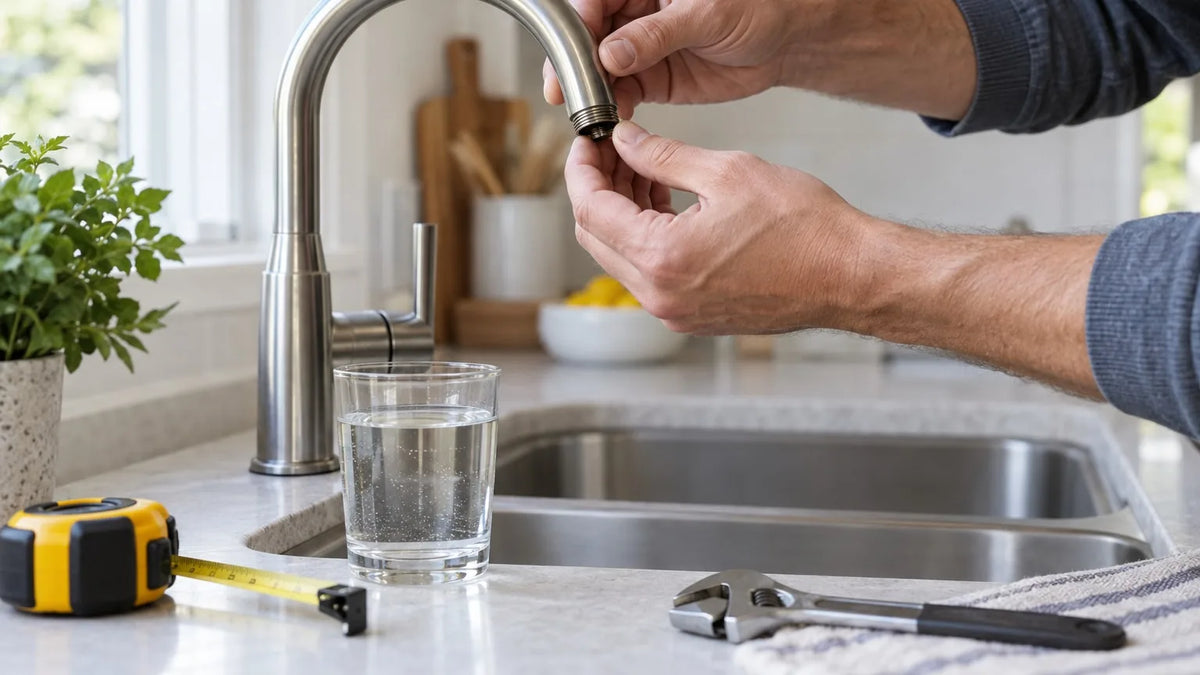
A good filter that won't fit your tap is still a bad buy. First check whether the end of the tap, known as the aerator, can be unscrewed. Then identify whether the thread is on the inside or outside of the spout, and compare its diameter with the adapters supplied.
The shape of the tap matters too. Pull-out models, spray heads and some unusual spouts don't always allow a secure fit. A claim such as “compatible with most taps” should therefore come with a precise diagram.
2. What each filter material does
Two filters that look alike can work very differently. Activated carbon works in particular on chlorine and on certain compounds responsible for unpleasant tastes or smells. A ceramic microfiltration element, on the other hand, forms a physical barrier whose fineness should be specified.
The number of “layers” tells you less than their type, their role and the associated results. An extra layer doesn't automatically mean better filtration.
3. How precise the filtration claims are
Look for measurable wording: substance targeted, stated reduction, filtration fineness and reference to tests. Be wary of absolute expressions such as “removes everything”.
Reducing a contaminant doesn't necessarily mean removing it entirely. Nor can the result be extended to a whole family of substances: data on PFOA, for example, does not on its own prove identical performance on all PFAS.
4. Filtered flow rate
The flow rate determines how convenient it is to fill a water bottle, a saucepan or a jug. To compare two models objectively, look for a figure in litres per minute and check whether the measurement conditions are stated.
A tap filter dispenses water on demand, unlike a jug you have to fill and then wait for. That doesn't mean all models have the same flow rate, though. If no figure is available, don't turn an impression of speed into a measured performance.
5. Whether there's a selector
A selector lets you use filtered water for drinking, making tea or cooking, then switch back to unfiltered water for washing up or cleaning. This helps preserve the cartridge and avoids unnecessary replacements.
Check that the control is easy to reach once the filter is fitted and that the two positions are easy to identify.
6. The real cost of cartridges
The price of the unit is only part of the budget. Before buying, check:
- the stated lifespan;
- the factors that can shorten it;
- the price of a refill;
- its availability;
- how easy it is to replace;
- whether rinsing or priming is required.
A cartridge rated for several months may need changing sooner if the water carries a lot of particles or if you filter large volumes. Conversely, going past the stated lifespan to save on a refill is not a good idea.
7. Connection quality and usage limits
Leaks can result from an unsuitable fitting, a missing or misplaced seal, a cross-threaded connection or overtightening. Having adapters therefore doesn't guarantee a watertight installation on its own.
Choose a product that comes with seals, fitting instructions and clear compatibility exclusions. Also check what the filter doesn't do: treat limescale, make an unknown source drinkable or work with hot water.
How do you check your tap is compatible before ordering?
You can check in a few steps, without taking the whole installation apart:
- Look at the spout. A standard unscrewable aerator is generally easier to fit a filter to than a built-in spray head.
- Unscrew only the removable end. Protect its finish and keep the part so you can return the tap to its original state.
- Identify the type of thread. See whether it is internal or external and make sure it is in good condition.
- Measure the diameter. Don't choose an adapter based on appearance alone.
- Check the manufacturer's diagram. The spout shape and fitting type should be clearly shown.
- Check the exclusions. A pull-out, square, very wide or unthreaded tap should not be assumed to be compatible.
For the Baytiz tap water filter, stated compatibility is around 85% thanks to the threads and adapters included. You must still check the compatibility image on the product page before ordering. Pull-out, spray or unusual taps are not assumed to be compatible without confirmation from this image.
When fitting, place the seal provided, start the thread straight and begin tightening by hand. If the part resists straight away, don't force it: check the diameter and direction of the thread. Once fitted, turn the water on gradually and watch the connection.
Does a tap filter improve the taste and smell of chlorine?
Yes, a filter containing activated carbon can reduce chlorine as well as its unpleasant taste and smell. This is one of the most sensible uses of a filter fitted to mains water that is already drinkable.
The result you notice will vary, however, depending on the water's original composition, the condition of the cartridge and the flow rate. An improvement in taste should not be confused with a full analysis of water quality. More neutral-tasting water does not, on its own, prove that every possible contaminant has been removed.
The Baytiz model combines activated carbon with ceramic rated down to 0.1 micron. It is designed to reduce chlorine and its smell and taste, while also targeting other substances specified in the laboratory tests provided. This combination therefore addresses both taste and mechanical filtration, without promising absolute purification.
How often should you replace the cartridge?
The right frequency is the one stated for the cartridge in question, adjusted to your actual use and water quality. There is no universal lifespan that applies to all tap filters.
For the Baytiz model, replacement is due after about three months. This can vary depending on how much water you filter and the characteristics of your mains water. Using the selector so you don't filter washing-up water helps keep the cartridge's capacity for the uses that matter.
To avoid forgetting, note the installation date in your diary. Don't just wait for an unpleasant taste to come back: a cartridge can reach the end of its life without any dramatic change in taste. An unusual drop in flow should also prompt you to check the filter and the fitting, without automatically assuming it's faulty.
Which type of filter should you choose for your situation?
| Your situation | Best option | Why |
|---|---|---|
| Standard tap with an unscrewable aerator | Filter fitted directly to the tap | Instant access to filtered water, with no jug to fill |
| Bothersome chlorine taste or smell | Model containing activated carbon | Activated carbon is suited to reducing chlorine and the related taste issues |
| Family use for drinking and cooking | Model with a selector and available refills | The selector stops you using up the cartridge on washing-up |
| Pull-out, spray or unusual tap | Strict checking or a solution that doesn't depend on the tap | Fitting a filter to the spout may be impossible or unstable |
| Need without connecting to the tap | Baytiz gravity water filter | This type doesn't depend on the spout's thread |
| Need on the go | Baytiz water filter bottle | A format better suited to carrying around than a device fixed in the kitchen |
| Main goal: reducing limescale | A solution specifically documented for this use | An activated carbon filter should not be treated as a water softener |
What are the most common buying mistakes?
- Buying before checking the thread. The number of adapters is no substitute for measuring your tap.
- Choosing only on the number of filtration stages. The type of media and documented results are more useful than a marketing figure.
- Assuming a filter removes limescale. Unless this performance is explicitly stated, an activated carbon filter is not a water softener.
- Forgetting the price of refills. An affordable unit can become a hassle if cartridges are hard to find or expensive.
- Filtering all the water you use. Water for washing up wears out the cartridge needlessly.
- Forcing an adapter. A cross-threaded fitting can cause a leak or damage the connection.
- Using the filter on non-drinking water. A household tap filter isn't automatically designed to make a source of unknown microbiological quality safe.
- Reading “reduction” as “complete removal”. Always stick to the exact scope of the stated results.
Is the Baytiz tap water filter right for your kitchen?
The Baytiz tap filter is best suited to people who have a compatible tap and want to filter mains water that is already drinkable straight from the tap. Its cartridge combines ceramic down to 0.1 micron with activated carbon. It has a stainless steel body and a selector for switching between filtered and unfiltered water.
According to the laboratory tests provided, this technology is designed to reduce chlorine, fine particles, microplastics, bacteria, parasites, pesticides, pharmaceutical residues and PFAS such as PFOA. This should be understood as targeted reduction, not as a guarantee that every substance is completely removed.
Installation is stated to take about two minutes, with no under-sink work and no tools: remove the tap's aerator, choose the adapter, fit the seal, then screw on the filter. The deciding factor is still compatibility. Check the diagram on the product page before buying, especially if your tap has a spray head or an unusual shape.
This product isn't the right choice if you want to make untested spring water drinkable, soften hard water or get precise data on changes to minerals. No limescale reduction performance and no mineral retention or reduction rate are claimed.
Check the Baytiz filter's adapters to equip your kitchen without permanent work.

Tap Water Filter
Check my tap is compatible →Frequently asked questions
Should you run the water after fitting a new cartridge?
Follow the rinsing or priming procedure given in the cartridge instructions. The time needed can vary with the filter material, so it's better to follow the manufacturer's instructions than to pick an arbitrary time.
Can you use hot water in a tap filter?
Don't run hot water through the filtered mode without checking the maximum temperature stated in the instructions. Heat can affect some filter materials or parts of the housing. If there is no clear guidance, only filter cold water.
Can a tenant fit a filter to their tap?
A model fitted in place of the aerator can generally be removed and needs no under-sink work. Keep the original aerator and avoid any irreversible changes. You still need to check the tap's compatibility before buying.
Can you use filtered water for coffee, tea and cooking?
Yes, when the water you start with is already drinkable and the filter is designed for this use. The Baytiz model lets you fill glasses, water bottles, kettles and saucepans directly, then switch back to unfiltered water for washing up.
Is an under-sink filter always better than a tap filter?
No. An under-sink system can be worthwhile for a permanent installation or greater needs, but it takes up more space and involves more fitting. A tap filter puts simplicity, reversibility and instant access first. The best choice therefore depends on your installation and daily volume, not just on the product category.
Choosing the right filter without relying on promises alone
To find the best tap water filter, start with your kitchen spout: type of aerator, thread, diameter and shape. Then compare the filter materials, the substances actually targeted, the documented flow rate, the selector and the cost of cartridges.
If your tap is compatible and your priority is to improve the taste of drinkable water while having filtered water on tap instantly, the Baytiz model combines ceramic, activated carbon and a selector in a stainless steel body. The logical next step is to check the Baytiz filter's compatibility diagram so you can choose the right adapter for your kitchen.