Best water filter bottle: a comparison by water source and capacity
Contents
The best water filter bottle isn't simply the one that claims the most litres. It has to suit the water available, the number of people, how long you'll go without a refill and the effort needed to drink. For a solo hike with regular freshwater sources, a 600 to 700 ml bottle with built-in filtration is often the most practical compromise. For a group or wild camping, a gravity filter is generally more suitable.
With a stated capacity of 680 ml, a 0.01-micron ultrafiltration membrane and a filter life of up to 1,500 litres, the Baytiz water filter bottle is a sensible option for drinking straight from the bottle on the trail. It does, however, require harder sucking than an ordinary straw and is not suitable for seawater or water that may be chemically polluted.
Key points
- Choose first according to the water source and the contaminants targeted, not just the stated filter life.
- A capacity of around 680 ml is practical for one person if refills are regular, but limited for a group or a long stretch without water.
- Filter life in litres is theoretical: water turbidity, maintenance and actual flow rate all affect how long it lasts.
- Microbiological filtration doesn't make all water drinkable: salt, fuel, pesticides and other chemical pollutants mean you should avoid the source.
- Ease of drinking, cleaning and drying the filter matter as much as its stated performance.
Which water filter bottle should you choose for your use?
Before comparing models, you need to tell the main systems apart. They don't meet the same need: drinking immediately, producing several litres at camp or having a very compact emergency backup.
| Solution | Advantages | Limitations | Best use |
|---|---|---|---|
| Baytiz suction water filter bottle | Bottle and filter in one, 680 ml capacity, handle and carabiner, filters as you drink | Harder sucking than with a standard straw, individual volume, must be kept upright while drinking | Day hikes, travel, camping and personal emergency kits |
| Squeeze water filter bottle | Depending on the model, lets you drink or transfer filtered water | Squeeze force, flow rate and leak-tightness must be checked for each model | Anyone who wants to filter before pouring water into another container |
| Water filter straw | Minimalist format, easy to keep as a backup | No built-in reservoir; you have to drink at the source or bring a compatible container | Emergencies, light outings and minimal bulk |
| Gravity filter | Treats a volume for several uses without sucking every sip | Needs setting up, less immediate while walking | Wild camping, groups, cooking and filling several containers |
| Tap filter | Everyday use at a fixed water point | Not suitable for collecting water from a river or lake | Home, kitchen and mains water compatible with the device |
So the verdict depends on the scenario. For drinking on your own throughout a walk, the integrated bottle is the most direct solution. For producing water at camp, it's better to look at a gravity water filter. If the top priority is keeping an emergency kit compact, a mini water filter may make more sense. At home, a tap water filter meets a different need.
Which criteria make the best water filter bottle?
A comparison of water filter bottles becomes genuinely useful when it separates verifiable performance from general claims. Here are the points to check on the spec sheet and in the instructions.
1. The contaminants actually tested
A filtration size alone isn't enough to prove effectiveness against all contaminants. Look for test results showing the organisms tested and the rates achieved. The Baytiz instructions notably state over 99.99% removal of Escherichia coli and Staphylococcus aureus, and 99.97% for Candida albicans, in independent laboratory tests.
These results should not be turned into a universal promise. They do not show the removal of all viruses, dissolved salts, pesticides, fuels or industrial discharge. A serious bottle should specify the types of water to avoid.
2. How you drink
Three methods are common: sucking through the filter, squeezing the container or filtering the water before pouring it. A fine membrane and activated carbon resist the flow of water. With the Baytiz, you need to suck with your mouth, as with a baby's bottle, rather than breathe in with your lungs.
This detail matters if you want to drink quickly during exertion or if strong resistance bothers you. In the absence of a standardised flow rate measurement, it's more honest to assess the action required and how the flow changes after several uses.
3. The weight you actually carry
Compare the net weight of the empty bottle, not the packaged weight. For the Baytiz, the figure available is a packaged weight of 320 grams: this doesn't give a precise weight for the product alone. A full 680 ml bottle also carries around 680 grams of water, plus the container, the filter and the accessories.
This distinction avoids a misleading comparison between a straw on its own, an empty bottle and a full bottle.
4. Carrying and access to the filter
A good bottle should be easy to grab, clip on and take apart. The Baytiz has a handle that lets you carry it with two fingers and a carabiner for clipping it to a bag. Its filter straw is removable: it comes out by pulling it downwards and goes back in by pushing it until it is properly in place.
5. The maintenance set out by the manufacturer
A filter rated for a large volume is less useful if it's hard to clean or stays damp in a closed container. Check whether it can be backflushed, the drying instructions and the signs that it needs replacing.
What capacity is practical for a hike?
There's no ideal capacity for every hike. The right volume depends on the distance between two reliable water sources, the temperature, the effort, your personal needs and whether you can top up.
A 680 ml bottle, like the Baytiz, is best for individual use with water sources spread along the route. It's easier to handle than a large reservoir and lets you refresh your water regularly. However, it isn't a sufficient supply for several people, for cooking or for a long stretch with no water.
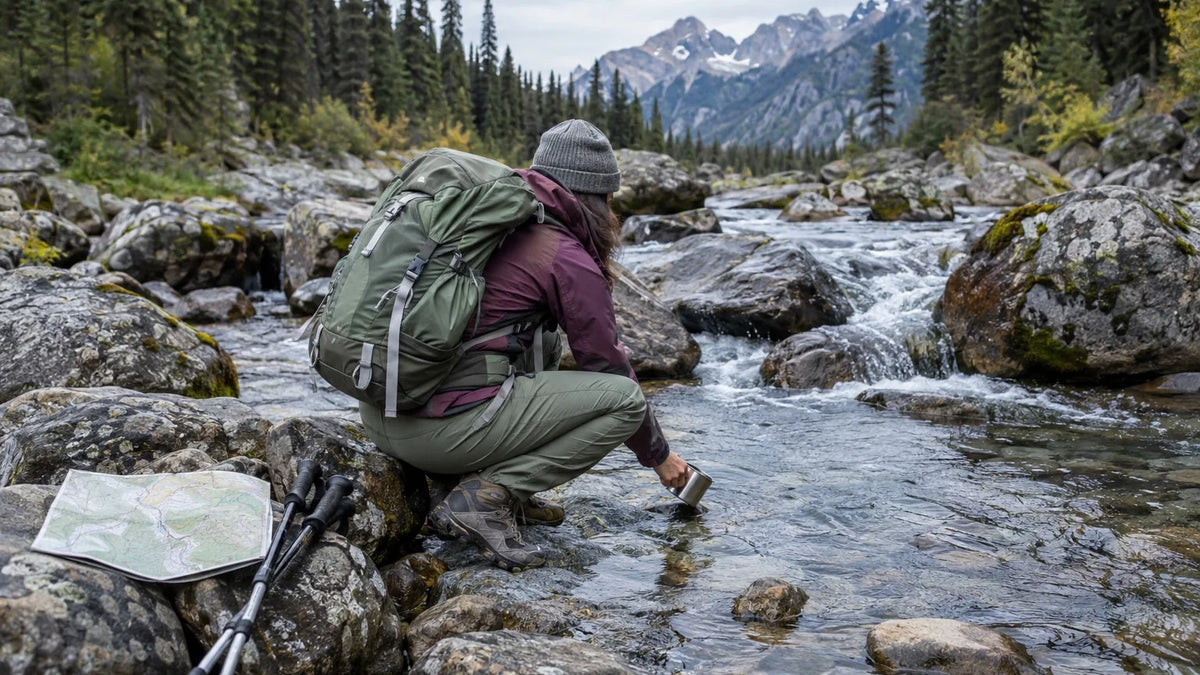
Before setting off, study the route and always allow a margin. A lake or stream on a map guarantees neither its seasonal flow nor the quality of its water. For wild camping, combining a shared system with clean containers is generally more practical than a single personal bottle.
How do you compare filter life?
Filter life should be compared in litres, but also under real conditions. The Baytiz filter straw can reach 1,500 litres once in use. This figure does, however, depend on water quality, consumption and maintenance. Water carrying a lot of sediment can reduce the flow rate and mean more frequent cleaning.
To turn filter life into a duration, divide the stated maximum volume by how much filtered water you drink per day. As a purely mathematical example, 1,500 litres divided by 2 litres a day equals 750 days of use. This result is theoretical: it is neither a guaranteed lifespan nor an automatic replacement date.
You also need to distinguish between two figures:
- Shelf life before use: an unused Baytiz straw can be kept for up to six years, which can suit an emergency kit.
- Capacity once in use: up to 1,500 litres, subject to water quality and proper maintenance.
The filter must be replaced if the flow remains unusually weak after several cleanings, if the water takes on an unusual taste or smell, if the straw is damaged or if it has been stored damp for so long that mould could have developed.
Is a water filter bottle suitable for all water?
No. Even the best water filter bottle won't let you drink any water at all. With the Baytiz, choose fresh water that is as clear as possible: rivers, streams, lakes, springs, natural fountains, cleanly collected rainwater, melted snow, well water of known quality or tap water.
If the water is very cloudy, let the sediment settle and then take the clearest part. Settling doesn't disinfect the water, but it avoids pushing a large amount of sediment through the filter unnecessarily.
Rule out the source if there's an odd smell, an unusual colour, algae, foam or a risk of pollution upstream. The instructions specifically exclude:
- seawater and brackish water;
- wastewater and sewage;
- water that may contain oil or fuel;
- sources exposed to pesticides and industrial or agricultural discharge;
- rainwater collected from a roof;
- wells of unknown quality.
The activated carbon in the Baytiz bottle is intended to improve the taste of the water. It should not be treated as a universal chemical treatment or desalination system. If in serious doubt, the right decision is to choose another source.
When should you choose the Baytiz water filter bottle?
The 680 ml Baytiz water filter bottle is particularly suited to someone who wants to fill up along the way and drink directly, with no pump or separate pouch. Its system combines an ultrafiltration membrane rated at 0.01 micron with granular activated carbon.
Its main practical advantages are its handle, its carabiner, its pre-fitted straw and the option of swapping it for the standard straw supplied when the water is already drinkable. This set-up also lets you use the bottle with other drinks, but only without the filter.
Its limitations should also be part of the decision. Sucking takes more effort than with an ordinary straw. While drinking, the bottle must stay upright: a small hole near the compass lets air in, and water can come out of it if the bottle is tilted upwards. When the bottle is closed, this hole is sealed.
It is therefore best suited to hikes, travel and solo outings with access to suitable fresh water. To filter several litres for a group or for cooking, a gravity system will be more convenient.
Get equipped to filter the fresh water available along your route, while respecting the usage restrictions in the instructions.

Blue Water Filter Bottle
Filter as you hike →Which mistakes should you avoid with a water filter bottle?
- Choosing on the number of litres alone: also check the compatible water sources, the effort needed to drink and the care instructions.
- Confusing microbiological filtration with universal treatment: a membrane doesn't make water contaminated by chemicals acceptable.
- Filtering drinks: with the Baytiz filter straw, use water only. Juice and tea are for the standard straw only.
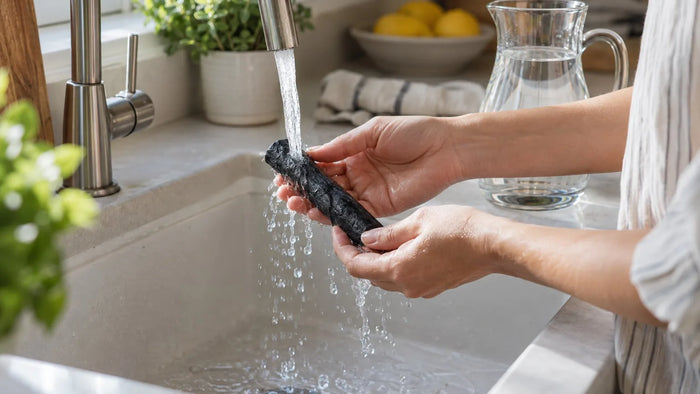
- Storing the filter while still damp: after a period of use, it should be backflushed, emptied and then dried in the open air in a dry, well-ventilated place.
- Using soap on the filter straw: mild soap is only for the body of the bottle.
- Putting the bottle in the dishwasher: never put the bottle or the filter straw in the dishwasher.
- Drinking with the bottle tilted upwards: keep the Baytiz upright to stop water coming out of the air hole.
Frequently asked questions
How do you prime a new water filter bottle?
Fill the bottle with the water to be treated, close the cap, then suck several times. The first few sucks may only draw air: the membrane and the straw first need to fill with water.
Why do you need to suck harder than with an ordinary straw?
The water has to pass through the 0.01-micron ultrafiltration membrane and the granular activated carbon. These two elements naturally create resistance. Suck with your mouth rather than breathing in with your lungs.
Can you use the bottle without its filter?
Yes. The Baytiz comes with a standard straw that can replace the filter straw. It can then hold water that is already drinkable, juice or tea. Drinks other than water must never pass through the filter.
How do you restore a weak flow?
Fill the small hole at the top of the straw with water, then blow to push the water through in the opposite direction to sucking. Repeat four or five times. If the flow is still unusually weak after several attempts, the filter may need replacing.
How do you look after the filter between outings?
If you're using it again the same day, remove the straw and blow several times into the mouthpiece, in the opposite direction to sucking, to push out the remaining water. For storage over several days, backflush it, empty the straw and leave it to dry in the open air before putting it away.
The verdict: focus on real-world use rather than a single ranking
To decide which water filter bottle to choose, start from three things: the water you'll come across, the volume you need between refills and how much you actually filter each day. A long filter life doesn't make up for a poor match with the water source or a drinking method that doesn't suit your needs.
For individual use, with regular freshwater sources and the wish to drink directly as you walk, the Baytiz water filter bottle offers a well-rounded package: 680 ml, suction filtration, up to 1,500 litres and carrying accessories. The logical next step is to check your route, identify the sources to avoid and choose the capacity that leaves you enough margin between refills.