How to clean a plastic water filter bottle without damaging the filter
Contents
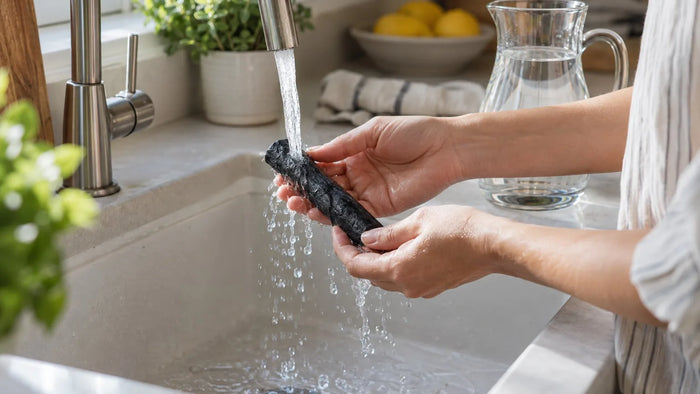
To clean a plastic water filter bottle, first remove the filter straw. Wash the bottle body by hand with water and, if needed, a mild soap, then leave it open to dry. The filter needs different treatment: no soap, no dishwasher and no storing it damp inside the closed bottle.
This distinction is essential with the Baytiz water filter bottle and its removable straw. Here is the complete routine to follow after a hike, along with the signs that tell you the filter element needs replacing.
Key points
- Wash the bottle by hand with water and, if necessary, a mild soap.
- Always remove the filter straw before washing: no soap should ever touch it.
- Before storing it for several days, backflush the filter, drain the remaining water and let it dry separately.
- Never use the dishwasher, either for the bottle or for its filter straw.
- Replace the filter if it is damaged, has been stored damp for a long time or if the flow stays very weak after several cleanings.
Which parts of a water filter bottle can be washed normally?
A water filter bottle isn't cleaned as a single unit. The bottle body holds the water before filtration, while the straw contains an ultrafiltration membrane and activated carbon. The two parts must therefore be separated before cleaning.
| Part | How to clean it | Avoid |
|---|---|---|
| Plastic bottle body | Hand wash with water and, if needed, a mild soap | Dishwasher |
| Cap and mouthpiece | Hand wash, then rinse thoroughly | Reassembling or closing before it is dry |
| Standard straw | Remove before washing the bottle body, especially after a drink other than water | Mixing it up with the filter straw |
| Filter straw | Drain the remaining water and, before long-term storage, backflush | Soap, dishwasher and storing damp in a closed container |
On the Baytiz bottle, the straw comes out by simply pulling it downwards. To put it back, push it upwards until it is firmly in place. The filter straw intended for water can be swapped for the standard straw supplied when you're using water that is already drinkable or another permitted drink.
How do you clean a water bottle after a hike?
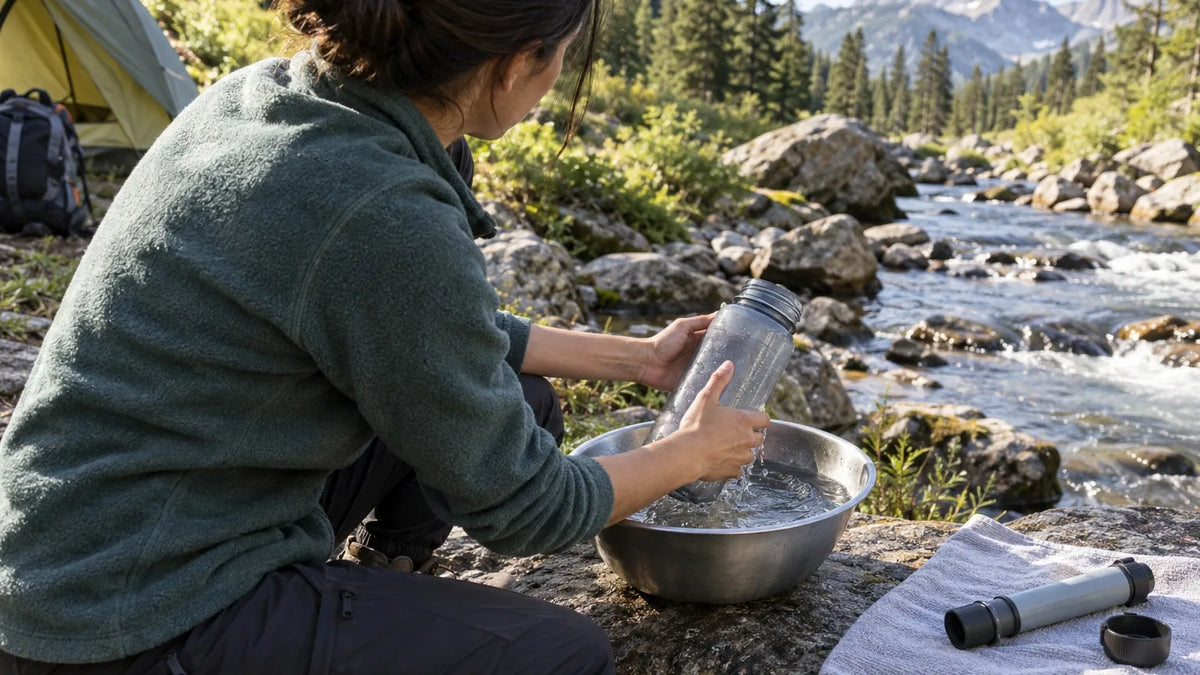
Clean the bottle as soon as you get back rather than leaving water standing until your next outing. It doesn't take long, but following the steps in the right order keeps soap out of the filter.
- Empty out any remaining water. Don't keep water collected from a river, lake or spring for several days.
- Remove the filter straw. Pull it downwards before adding any cleaning product to the bottle.
- Wash the bottle body by hand. Use water and, if necessary, a small amount of mild soap. Also clean the cap and the areas that touch your mouth.
- Rinse the washed parts thoroughly. No soap residue should remain in the bottle body or on the mouthpiece.
- Clean the filter separately. The method depends on how long it will be until you next use it.
- Leave everything to dry, taken apart. Put the parts in a dry, well-ventilated place. Only close the bottle once everything is completely dry.
If the water you collected was very cloudy, the instructions recommend letting it settle before filling the bottle, then taking the clearest part. This limits the amount of sediment reaching the straw, but does not make a source with an odd smell or colour, algae or foam acceptable.
How do you look after the filter straw without damaging it?
If you'll be using the bottle again the same day
Remove the filter straw, then blow several times into the mouthpiece, in the opposite direction to sucking. This pushes out the remaining water. It requires no soap or disinfectant.
If you won't be using the bottle for several days
Start by backflushing. Fill the small hole at the top of the straw with water, then blow to push the water through in the opposite direction to sucking. Then blow into the mouthpiece to drive out as much remaining water as possible.
Leave the straw to dry in the open air, in a dry, well-ventilated place. It must not be left damp for several days in a closed bottle or an airtight container.
If the flow has become unusually weak
Having to suck harder than with an ordinary straw is normal: the membrane filters down to 0.01 micron and the activated carbon naturally resists the flow of water. However, a marked drop in flow can mean the filter needs cleaning.
In that case, fill the small hole at the top with water and blow in the opposite direction. Repeat four or five times, refit the straw, then check the flow again. If the problem persists after several attempts, contact Baytiz or consider replacing the straw.
How do you prevent odours and damp between outings?
Odours develop more easily when damp parts are shut in together. After washing, dry the bottle body, the cap and the straw separately. Choose a dry, well-ventilated spot.
- Don't put the straw straight back into the bottle.
- Don't close the cap while the inside is still damp.
- Drain any water in the filter before storing it.
- Don't try to mask an unusual smell from the filter with a scented product.
If the smell comes only from the bottle body, wash it by hand again with a mild soap, then rinse and dry it completely. If the filtered water has an unusual taste or smell, cleaning the bottle itself won't be enough: the instructions recommend replacing the filter straw.
A straw that has stayed damp for a long time should not simply be rinsed and put back into use. Mould may have developed inside, in an area that is hard to inspect. Replacing it is then the recommended solution.
Which mistakes could damage the bottle or its filter?
- Putting the bottle in the dishwasher: the instructions only allow hand washing, for both the bottle body and the filter straw.
- Soaking the filter in soapy water: soap is only allowed for hand washing the bottle, never for the filter straw.
- Using vinegar, bicarbonate of soda, bleach or another home remedy in the filter: these methods are not part of the care described in the instructions. Stick to the recommended backflushing.
- Filtering juice, tea or a flavoured drink: the filter straw is for water only. Use the standard straw for the other drinks allowed.
- Storing the filter damp in the closed bottle: this encourages odours and can allow mould to grow.
- Carrying on with a damaged straw: cleaning cannot repair a membrane or a physically damaged part.
When should you replace the filter element?
Its lifespan doesn't depend only on how many months have passed. The quality of the water filtered, how often you use it and how well you look after it all affect the actual condition of the straw.
| Situation | What to do |
|---|---|
| Straw never used | Can be kept for up to 6 years |
| Straw used normally | Up to 1,500 litres of filtration, depending on the water, use and maintenance |
| Very weak flow | Backflush several times, then replace if the flow doesn't return |
| Unusual taste or smell | Replace the filter straw |
| Damaged straw | Stop using it and replace it |
| Stored damp for a long time | Replace it because of the risk of mould inside |
To keep track of use more easily, note the date of first use and estimate the volumes filtered over your outings. The 1,500-litre threshold is a stated maximum: it shouldn't lead you to keep a straw that already has a defect, a smell or an abnormal flow.
A water filter bottle designed to be cleaned in parts
To form an opinion on a water filter bottle, you need to look at the filtration, but also at how easily the parts in contact with the water can be separated. The 680 ml Baytiz water filter bottle has a removable straw already fitted and a standard straw supplied. This means you can remove the filter before washing the bottle body by hand.
Its filter straw combines a 0.01-micron ultrafiltration membrane with activated carbon. It is designed for various freshwater sources, with important limits: it is not suitable for seawater, wastewater or water that may be contaminated by chemicals, oil, fuel, pesticides or industrial and agricultural discharge.
The practical benefit: by taking the straw out after every outing and following the right drying routine, you reduce the risk of care mistakes that could shorten its life.

Blue Water Filter Bottle
Discover the water filter bottle →Frequently asked questions
What should you do the first time you use the filter?
Fill the bottle with the water to be treated, close the cap, then suck several times. The first few sucks may only draw up air: the straw first needs to fill up and get wet.
Why do you need to suck harder than with an ordinary straw?
The ultrafiltration membrane and the activated carbon naturally slow down the flow of water. Suck with your mouth, as you would when drinking through a straw, rather than trying to breathe in with your lungs. Normal resistance should not be confused with a completely blocked filter.
Does the small hole near the compass mean there's a leak?
No. This hole lets in the air needed for suction. Keep the bottle upright when you drink: the straw draws water from the bottom. If you tilt the bottle upwards, water may come out of this hole. When the bottle is closed, the hole is sealed.
Can you filter seawater or chemically polluted water?
No. The bottle is designed for fresh water from sources such as rivers, streams, lakes, springs, suitable rainwater, melted snow or tap water. It does not desalinate water and must not be used with brackish water, sewage or a source that may contain chemical pollutants. If in doubt, choose another source.
Can very cloudy water be poured straight into the bottle?
It's better to let it settle, then fill the bottle with the clearest part. Rule out any source with an odd smell or colour, algae or foam. Filtration doesn't remove the need to choose the most reliable water available.
A simple routine to look after your bottle
The right habit is to treat the washable plastic and the filter straw separately. After every outing, remove the filter, wash the bottle body by hand and leave the parts open to dry. Before a period without use, add a backflush and store the straw once it has dried in the open air.
To get ready for your next hikes with a system that comes apart, and to see its exact specifications, discover the Baytiz water filter bottle and its two straw options.